A new WMO assessment suggests that the world’s water systems are becoming less predictable. That shift has consequences far beyond climate policy: it affects infrastructure planning, regulation, investment and economic resilience.
For decades, water management was built on a basic assumption: historical patterns of rainfall, river flows and reservoir levels could provide a reasonable guide to future conditions. That assumption is becoming increasingly fragile.
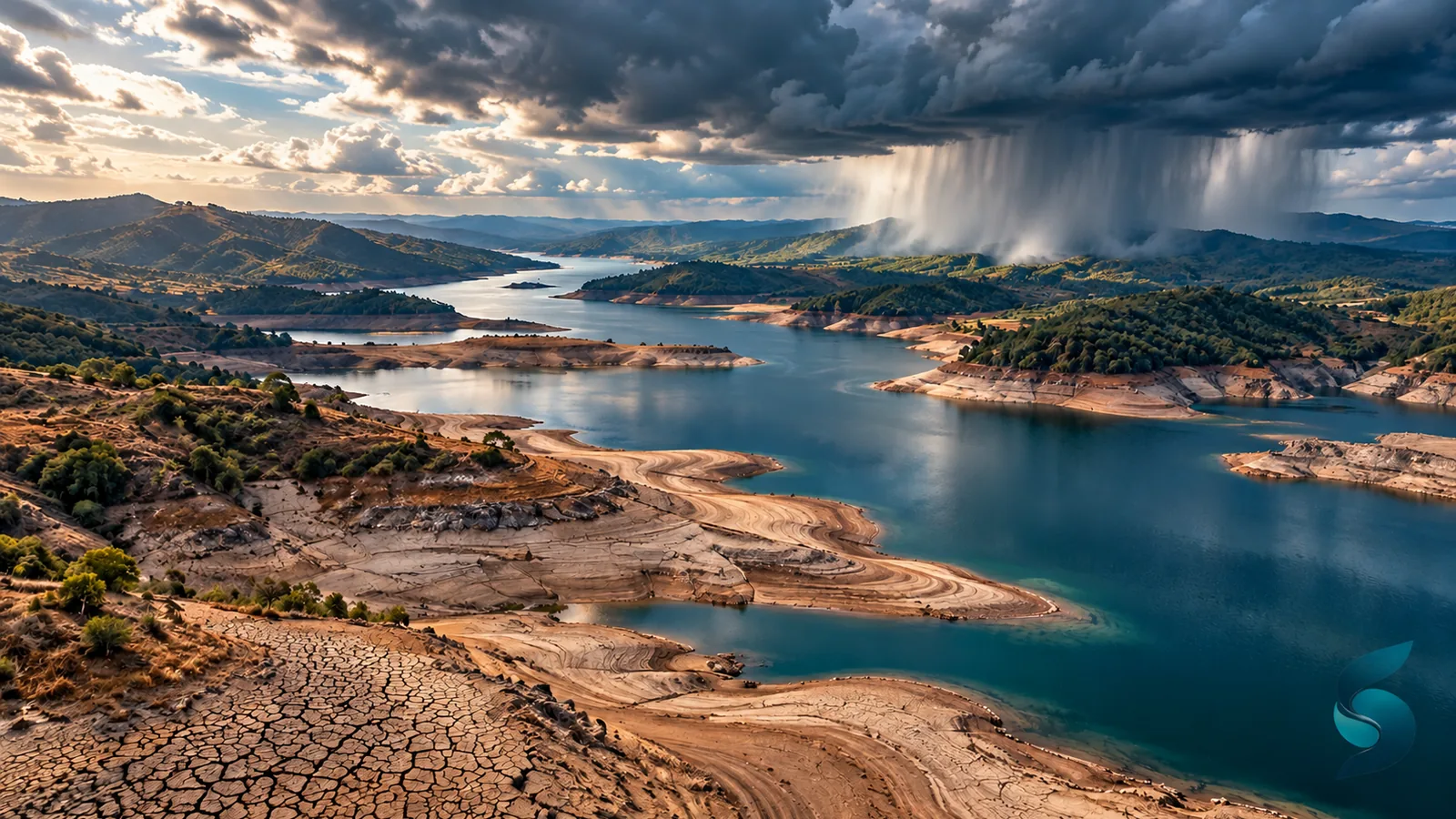
The World Meteorological Organization’s State of Global Water Resources 2025 shows that 2025 was among the weakest years for river flows in the past 35 years. Around 36% of global river basin areas recorded below-normal flows, while basins with conditions considered normal remained in the minority for the seventh consecutive year.
The message is not simply that droughts are becoming more frequent. It is that hydrological behaviour itself is becoming less predictable.
One of the report’s most important findings concerns terrestrial water storage — the water held in groundwater, rivers, lakes, soil, snow and ice. These reserves act as a buffer during dry periods. Yet the WMO identifies a persistent decline in terrestrial water storage since roughly 2014–2016.
Groundwater data reinforce the warning. In 2025, nearly two-thirds of monitored wells were outside their historical normal range, with deficits more common than recovery. Glaciers tell a similar story: all major glacier regions recorded net mass loss for a fourth consecutive year, with cumulative losses of about 1,400 gigatonnes of water between 2023 and 2025.
These trends matter because they are slow. A flood is visible. A reservoir crisis is visible. The gradual depletion of strategic water reserves is much easier to overlook.
Brazil is not outside this process. The WMO reports recurring below-normal flows in parts of the Amazon and La Plata basins between 2021 and 2025. In 2025, sections of the São Francisco basin also experienced below- or well-below-normal flows, while parts of eastern Brazil showed lower terrestrial water storage.
For Brazil, this is not only an environmental concern. It is an infrastructure, economic and regulatory issue. Electricity generation, agriculture, urban supply and industry all depend on reliable water availability.
This changes the logic of planning.
Historical records remain essential, but they are no longer sufficient on their own. Reservoir operations, water allocation permits, urban supply systems, irrigation projects and infrastructure design increasingly need to incorporate climate scenarios, real-time monitoring, hydrological forecasting and wider safety margins.
The same applies to water utilities. A system may appear efficient under normal conditions and still be highly vulnerable to a prolonged drought. A city may expand production while continuing to lose large volumes of treated water through its distribution network. A concession may meet investment targets while remaining dependent on a source that is becoming less reliable.
This is why source diversification, leakage reduction, reuse, aquifer protection, adequate storage and contingency planning must be treated as core water-security infrastructure.
Regulation must evolve as well.
Traditionally, utility performance has been assessed through tariffs, service quality, investment delivery and financial efficiency. Those indicators remain essential, but resilience now needs to become part of the equation.
Regulators will increasingly need to ask not only how much water a system can produce, but how long it can continue to operate when hydrological conditions deteriorate.
That distinction is fundamental. A technically efficient utility can still operate a fragile system. A financially balanced concession can still depend on an increasingly unreliable source.
The WMO’s message is therefore more complex than the idea that the world will simply become drier. In many places, the challenge will be too much water, too little water, or water arriving in the wrong place or at the wrong time.
That irregularity may prove as disruptive as scarcity itself.
The next generation of water policy will not be defined only by how much water is available. It will be defined by how well institutions manage uncertainty, reduce exposure and build resilience before the crisis arrives.
When hydrological normality becomes less reliable, water security stops being merely the management of supply. It becomes the management of risk.
Sources: World Meteorological Organization (WMO), State of Global Water Resources 2025 and Recent water trends have serious future implications (September 17, 2026); Brazil’s National Water and Basic Sanitation Agency (ANA), Conjuntura dos Recursos Hídricos no Brasil 2025.
* Thiago Giron Garcia is a Master’s student in Water Resources Management and Regulation at UNESP, with a background in Business Administration, Public Management, Production Engineering, Environmental and Sanitary Engineering, and Water Supply and Wastewater Systems.
As opiniões expressas neste artigo são de responsabilidade do autor.